Monday, December 26, 2022

The Second Day of Christmas 2022

Boxing Day, or the Feast of Stephen

Today, in many places with connections to the United Kingdom, is Boxing Day.  Boxing in this instance refers to the practice of preparing a Christmas box typically for postmen, errand boys, and other servants, consisting of gifts and gratuities to them for their service throughout the year.  It was given on the day after Christmas since they were most often having to work and serve on Christmas Day.  

From growing up in the family business, I really appreciate Boxing Day.  We always closed December 26 and enjoyed the day.  It was our holiday, since we would be open for nearly a complete work day on Christmas Eve.  We would take Christmas and the day after as our holidays because it impacted fewer customers.

Today is also Saint Stephen's Day.  A celebration of the life of Saint Stephen, the first Christian martyr, with a feast in his honor.  And the Feast of Stephen makes me think of a Bohemian king.

Good King Wenceslas, Saint Wenceslaus I, Duke of Bohemia. Rex Iustus, the righteous king. 

Wenceslas was considered a martyr and a saint immediately after his death, viewed as a monarch whose power stems mainly from his great piety, as well as from his vigor. “But his deeds I think you know better than I could tell you; for as is read in his Passion, no one doubts that, rising every night from his noble bed, with bare feet and only one chamberlain, he went around to God’s churches and gave alms generously to widows, orphans, those in prison and afflicted by every difficulty, so much so that he was considered, not a prince, but the father of all the wretched.”

Oh, if that could be said of us.

So in this time, when all the gifts have been given, and we are basking in what we have received, may we take time to remember the less fortunate, the poor, the widowed, the orphan, the imprisoned, and the low.

And perhaps, we could all join in a chorus of his carol.

Good King Wenceslas looked out, on the Feast of Stephen, 
When the snow lay round about, deep and crisp and even; 
Brightly shone the moon that night, tho' the frost was cruel, 
When a poor man came in sight, gath'ring winter fuel. 

"Hither, page, and stand by me, if thou know'st it, telling, 
Yonder peasant, who is he? Where and what his dwelling?" 
"Sire, he lives a good league hence, underneath the mountain; 
Right against the forest fence, by Saint Agnes' fountain." 

"Bring me flesh, and bring me wine, bring me pine logs hither: 
Thou and I shall see him dine, when we bear them thither." 
Page and monarch, forth they went, forth they went together; 
Through the rude wind's wild lament and the bitter weather. 

"Sire, the night is darker now, and the wind blows stronger; 
Fails my heart, I know not how; I can go no longer." 
"Mark my footsteps, good my page. Tread thou in them boldly 
Thou shalt find the winter's rage freeze thy blood less coldly." 

In his master's steps he trod, where the snow lay dinted; 
Heat was in the very sod which the saint had printed. 
Therefore, Christian men, be sure, wealth or rank possessing, 
Ye who now will bless the poor, shall yourselves find blessing.

Sunday, December 25, 2022

The First Day of Christmas 2022

"In those days a decree went out from Caesar Augustus that all the world should be registered.  This was the first registration when Quirinius was governor of Syria.  And all went to be registered, each to his own town.  And Joseph also went up from Galilee, from the town of Nazareth, to Judea, to the city of David, which is called Bethlehem, because he was of the house and lineage of David, to be registered with Mary, his betrothed, who was with child.  And while they were there, the time came for her to give birth.  And she gave birth to her firstborn son and wrapped him in swaddling cloths and laid him in a manger, because there was no place for them in the inn.


And in the same region there were shepherds out in the field, keeping watch over their flock by night.  And an angel of the Lord appeared to them, and the glory of the Lord shone around them, and they were filled with great fear.  And the angel said to them, 'Fear not, for behold, I bring you good news of great joy that will be for all the people.  For unto you is born this day in the city of David a Savior, who is Christ the Lord.  And this will be a sign for you: you will find a baby wrapped in swaddling cloths and lying in a manger.'  And suddenly there was with the angel a multitude of the heavenly host praising God and saying,

'Glory to God in the highest,
and on earth peace among those with whom he is pleased!'

When the angels went away from them into heaven, the shepherds said to one another, 'Let us go over to Bethlehem and see this thing that has happened, which the Lord has made known to us.'  And they went with haste and found Mary and Joseph, and the baby lying in a manger.  And when they saw it, they made known the saying that had been told them concerning this child.  And all who heard it wondered at what the shepherds told them.  But Mary treasured up all these things, pondering them in her heart.  And the shepherds returned, glorifying and praising God for all they had heard and seen, as it had been told them."

I think we often run the risk of over-sanitizing the Christmas story.  Because of what we have made worship, what we have made religion, we view holy as orderly, as clean, as quiet, as presentable.  We've made that first Christmas, a silent night, a beautiful ordered pageant, worthy of a king.

In reality, that first Christmas was messy.  It wasn't pretty.

It was chaotic.

If it were us, we might look back at the time as our worst Christmas ever.

Joseph and Mary had their lives interrupted three times in a very short time.  Their planned marriage quickly turned into a scandal.  An unplanned pregnancy.  The requirement that they travel over 100 miles to Bethlehem to be taxed.  And then becoming refugees in Egypt to escape a tyrannical government.

We noticed last night that Joseph and Mary were still not married when Jesus was born.  They were still in the betrothal stage.  Jewish marriages were not completed until they were consummated, and we know Joseph did not know Mary until after Jesus was born.  Think of that, Jesus was born to unwed parents.

We have to wonder why Joseph and Mary were looking for an inn in Bethlehem.  Bethlehem was where Joseph's family was from.  In a culture where family was of the utmost importance, did they not have family any more that would take them in?  Were they ostracized from their family because of Mary's pregnancy?

The stable as well was the most unfortunate of places to be born.  It would have smelled of animal feces and urine.  It would have been dark, damp, cold.  The birth would have involved blood, and other human excretions.  A most unsanitary birthing room.  It would have involved pain and screaming.  The cries of Mary and Jesus.

And the bonding time with the baby was interrupted by ultimate outsiders, dirty, smelly shepherds.  The runts of the litter.  People who spent a little too much time with the animals.

In all that chaos, it was no less holy.  It was no less miraculous, no less worship.

So, to everyone who's life is messy, Merry Christmas!

To everyone who's life has been interrupted for the second, third, fourth time...
To everyone who is homeless...
To everyone without family...
To everyone with complicated family relationships...
To everyone at their lowest...
To everyone who is running....
To the refugees...
To the ostracized...
To the outcast...
To anyone who feels dirty, downtrodden, unloved...

Merry Christmas!

The Child is born, and He is here for all.

God bless us, everyone...

Saturday, December 24, 2022

Yuletide - Christmas Eve 2022

It's Christmas Eve.  I pray you and yours have a wonderful night.  May the night be spent with those you love and may the blessings of the season be upon you.  May it be all you hope for, and all you need.


'Twas the night before Christmas, when all through the house
Not a creature was stirring, not even a mouse;
The stockings were hung by the chimney with care
In hopes that St. Nicholas soon would be there;

The children were nestled all snug in their beds,
While visions of sugar-plums danced in their heads;
And mamma in her kerchief, and I in my cap,
Had just settled our brains for a long winter's nap,

When out on the lawn there arose such a clatter,
I sprang from the bed to see what was the matter.
Away to the window I flew like a flash,
Tore open the shutters and threw up the sash.

The moon on the breast of the new-fallen snow
Gave the lustre of mid-day to objects below,
When, what to my wondering eyes should appear,
But a miniature sleigh, and eight tiny reindeer,

With a little old driver, so lively and quick,
I knew in a moment it must be St. Nick.
More rapid than eagles his coursers they came,
And he whistled, and shouted, and called them by name:

"Now, Dasher! now, Dancer! now, Prancer and Vixen!
On, Comet! on, Cupid! on, Donder and Blitzen!
To the top of the porch! to the top of the wall!
Now dash away! dash away! dash away all!"

As dry leaves that before the wild hurricane fly,
When they meet with an obstacle, mount to the sky;
So up to the house-top the coursers they flew,
With the sleigh full of Toys, and St. Nicholas too.

And then, in a twinkling, I heard on the roof
The prancing and pawing of each little hoof.
As I drew in my head, and was turning around,
Down the chimney St. Nicholas came with a bound.

He was dressed all in fur, from his head to his foot,
And his clothes were all tarnished with ashes and soot;
A bundle of Toys he had flung on his back,
And he looked like a peddler just opening his pack.

His eyes--how they twinkled! his dimples how merry!
His cheeks were like roses, his nose like a cherry!
His droll little mouth was drawn up like a bow,
And the beard of his chin was as white as the snow;

The stump of a pipe he held tight in his teeth,
And the smoke it encircled his head like a wreath;
He had a broad face and a little round belly,
That shook when he laughed, like a bowlful of jelly.

He was chubby and plump, a right jolly old elf,
And I laughed when I saw him, in spite of myself;
A wink of his eye and a twist of his head,
Soon gave me to know I had nothing to dread;

He spoke not a word, but went straight to his work,
And filled all the stockings; then turned with a jerk,
And laying his finger aside of his nose,
And giving a nod, up the chimney he rose;

He sprang to his sleigh, to his team gave a whistle,
And away they all flew like the down of a thistle.
But I heard him exclaim, ere he drove out of sight,
"Happy Christmas to all, and to all a good-night."


A Visit From St. Nicholas, Clement Clarke Moore, 1823

Friday, December 23, 2022

Yuletide - Festivus 2022!


It's a Festivus for the rest of us.

Today marks the celebration of a very new holiday - Festivus.  Festivus was created for the 1997 episode of Seinfeld entitled "The Strike."  In the episode, it is revealed that George Costanza's family never really celebrated Christmas, but celebrated Festivus instead.  George's father, Frank, created the holiday after getting into a fight with another shopper over a doll one year.  Fed up with the commercial and religious aspects of Christmas, Frank set out to create his own celebration.  

Festivus is celebrated with a Festivus dinner, at which the family will partake in the Airing of Grievances and Feats of Strength.    The Airing of Grievances begins early into the dinner when Frank starts "I got a lotta problems with you people, and now you're going to hear about it!"  He then goes down around the table listing specific injuries.  The Feats of Strength is celebrated immediately after the dinner when the head of the household selects a person for a wrestling match.  Festivus then only ends when the head of household is pinned in the match.  Traditional Festivus decoration is a bare aluminum pole.

It's a comical holiday, but has gained some larger adoption.

We've celebrated Festivus, sort of, pretty regularly in our family, though our practices are a lot closer to Christmas.  Christmas Eve Eve has been our little family's Christmas.  Since we are usually at one of the grandparents' houses for Christmas Eve and Christmas Day, December 23 was our opportunity to have dinner, exchange presents, and watch a Christmas movie.  We've taken to eating Chinese food, a nod to A Christmas Story.  We still exchange presents, though our movie has changed, switching from Love Actually pre-kids, to something a little more family friendly.

It's our little day and though we've moved up our celebration, we still will be partaking in a little Festivus of our own, as before.

However you are spending the day, I hope you have a very Happy Festivus and a Merry Christmas ahead.

Thursday, December 22, 2022

Yuletide - The Twelve Days of Christmas, An Overview

"On the twelfth day of Christmas, my true love gave to me..."

In preparation for the series of posts beginning December 25, I post this reminder of what the Twelve Days of Christmas actually refers to.

You may have noticed many businesses and organizations refer to a Twelve Days of Christmas celebration or sale now.  Some schools even started marking the Twelve Days of Christmas at the beginning of December, because they were only going to be to school twelve days in December before Christmas break.

Without proper context, you would think this could be an accurate use of the term.  The modern Christmas season has come to be defined officially as the period from Black Friday after Thanksgiving through Christmas Day.  Unofficially, it seems to begin the day after Halloween, or All Saints Day.  This is largely because the economic component of Christmas is so important, so the focus has shifted to the shopping related days before Christmas.  We can promote this shopping season through decoration, through music, through events leading into Christmas Day, and then get everyone to return their focus to work and productivity after that one singular day. 

But, while this might be our modern focus, we know this is not the proper usage, nor the correct time period for the Twelve Days.

This specific period of time starts on Christmas Day and then continues through Epiphany.  There is some debate as to whether day one starts on Christmas Day and then finishes the day before Epiphany, or whether the twelve day period starts on the day after Christmas and then includes Epiphany at the end.  Either way Christmas Day on December 25 and Epiphany on January 6 mark the bounds of the Twelve Days of Christmas, also known as Christmastide or Twelvetide. 

Those two bounds would be the markers because it reflects the entirety of the Nativity of Christ.  Christmas Day would celebrate the birth and the stable.  The shepherds arriving, angels appearing, and the spreading of the gospel.  Epiphany, or Three Kings Day, would mark the arrival of the Magi, completing the Nativity story.

The origins of this practice date back to 567 AD, where the Council of Tours proclaimed this twelve day period between Christmas Day and Epiphany as a sacred and festive season.  Advent, or the weeks leading into Christmas, would be the more somber and reflective preparation for the feast.  But Christmastide or Twelvetide would be the celebration and the feast.  

With that in mind, traditionally, decorations for Christmas, like the Christmas tree, would not go up until Christmas Eve and then would remain up through the celebration.  They would only be taken down between Twelfth Night, the eve of January 5, and the morning of Epiphany, January 6.

Likewise, gifts may have been given each of the twelve days of this period.  This provides the inspiration for the song.  Despite what you may have read, the song is not a catechism song, with encoded symbols for Christian theology.  The symbols can be seen, but could be done with any gifts assigned to the numbers.  In other words, the numbers there are all that matter.  Rather, the origins of the song are more likely simply in a children's memory and forfeit song, given the cumulative nature of the verses.  It would be sung and repeated to see which child forgot one of the gifts first.

Over time, celebrations have developed for each of the twelve days, whether they are feasts for the saints, or more secular and traditional holidays.  I've included a snapshot below for each of the celebrations, and will be writing about each day this season starting on Christmas Day.

  • The First Day of Christmas - December 25 - A Partridge in a Pear Tree
    • Christmas Day
  • The Second Day of Christmas - December 26 - Two Turtle Doves
    • St. Stephen's Day, or the Feast of Stephen
    • Boxing Day, a day to give gifts to the household staff or the poor, now mainly a shopping holiday
    • Feast days of Abadiu of Antinoe, James the Just, and Synaxis of the Theotokos
    • Earliest day of the Feast of the Holy Family (it would be celebrated here this year)
  • The Third Day of Christmas - December 27 - Three French Hens
    • Feast of St. John, Apostle and Evangelist
    • Feast days for Blessed Francesco Spoto, Blessed Sara Salkahazi, Fabiola, Pope Maximus of Alexandria, Nicarete, and Theodorus and Theophanes
  • The Fourth Day of Christmas - December 28 - Four Calling Birds
    • Feast of the Innocents, commemorating the Massacre of the Innocents, where Herod killed the children two and under in an attempt to kill the Christ child
    • Feast days for Abel, Caterina Volpicelli, and Simon the Athonite
  • The Fifth Day of Christmas - December 29 - Five Golden Rings
    • Memorial of St. Thomas Becket, Bishop and Martyr
    • Feast days for David, King and Prophet, Jonathan, Prince of Israel, and Trophimus of Aries
  • The Six Day of Christmas - December 30 - Six Geese a Laying
    • Feast days for Abraham the Writer, Anysia of Salonika, Egwin of Evesham, Frances Joseph-Gaudet, Liberius of Ravenna, Pope Felix I, Ralph of Vaucelles, and Roger of Cannae 
  • The Seventh Day of Christmas - December 31 - Seven Swans a Swimming
    • New Year's Eve
    • First Night
    • Watch Night
    • Hogmanay or "Auld Year's Night"
    • Feast day for Pope Sylvester I
  • The Eighth Day of Christmas - January 1 - Eight Maids a Milking
    • New Year's Day
    • The Solemnity of Mary, Mother of God
    • Feast of the Circumcision of Christ, as he would have been circumcised eight days after his birth.
    • Feast of the Holy Name of Jesus in some traditions
    • Feast of Fools
    • Feast days for Adalard of Corbie, Basil the Great, Fulgentius of Ruspe, Giuseppe Maria Tomasi, Telemachus, and Zygmunt Gorazdowski
  • The Ninth Day of Christmas - January 2 - Nine Ladies Dancing
    • The second day of New Year
    • Feast of Sts. Basil the Great and Gregory of Nazianzus
    • Feast of the Holy Name of Jesus in some traditions
    • Feasts also for Defendens of Thebes, Johann Konrad Wilhelm Lohe, Macarius of Alexandria, Seraphim of Sarov, and Vedanayagam Samuel Azariah 
  • The Tenth Day of Christmas - January 3 - Ten Lords a Leaping
    • Memorial of the Holy Name of Jesus
    • Feasts for Daniel of Padua, Genevieve, Kuriakose Elias Chavara, Pope Anterus, and William Passavant
  • The Eleventh Day of Christmas - January 4 - Eleven Pipers Piping
    • Feasts for Angela of Foligno, Elizabeth Ann Seton, Ferreol of Uzes, Mavilus, Pharaildis of Ghent, and Rigobert
  • The Twelfth Day of Christmas - January 5 - Twelve Drummers Drumming
    • Twelfth Night, forever memorialized as the title for one of Shakespeare's works
    • Feasts for Charles of Mount Argus, John Neumann, Pope Telesphorus, and Simeon Stylites
  • Epiphany - January 6 - We Three Kings

A celebratory season indeed.  And an opportunity for a lot that we in our faith forget over the Christmas story.

Wednesday, December 21, 2022

Yuletide - Blue Christmas 2022

"In the bleak mid-winter
Frosty wind made moan;
Earth stood hard as iron,
Water like a stone;
Snow had fallen, snow on snow,
Snow on snow,
In the bleak mid-winter
Long ago.

Our God, heaven cannot hold Him
Nor earth sustain,
Heaven and earth shall flee away
When He comes to reign:
In the bleak mid-winter
A stable-place sufficed
The Lord God Almighty —
Jesus Christ.
"

Today marks the winter solstice or midwinter.  It's officially the shortest day of the year, and the longest night.  This is the period people think of when discussing seasonal depression.  When it truly looks darkest.

Today has also been traditionally Blue Christmas in Western Christianity, a day in the advent season marking the longest night of the year.   Many denominations hold church services that honor people that have lost loved ones and are experiencing grief.  

That hits home this year.  Churches not just being there immediately after a loss, but really continuing to deal with and acknowledge grief.  There are so many people struggling this year, so much work to do, and this is an important part of it.  I wish more denominations and churches were doing the same.

Blue Christmas also coincides with the traditional day of the Feast of St. Thomas.  Thomas the doubter.  You have a convergence of a recognition of Thomas's struggle to believe in Jesus's physical resurrection, the long winter nights before Christmas, and the struggle of the darkness and grief that is faced by people dealing with loss, depression, loneliness, anxiety, etc.  

It's a reminder that the holidays are not always a joyous time for a multitude of reasons, and that we are still to show love and care to those who may be in such a situation.  That we should recognize them.  Honor them.  And struggle alongside them.

Do you know how many people in your midst are really hurting right now?

May this midwinter be a good time to pause and reflect.  May we be aware of our surroundings and the situations of those around us.  May we be responsive to the need.  

The joy will come.  The light shines in the darkness, breaking that great darkness right before the dawn.  

But for tonight, we remember the night, and those that it is affecting.

Tuesday, December 20, 2022

Yuletide - Let There Be Peace on Earth


“I heard the bells on Christmas Day
Their old familiar carols play,
And mild and sweet the words repeat
Of peace on earth, good-will to men!”


“And suddenly there was with the angel a multitude of the heavenly host praising God, and saying,

Glory to God in the highest, 

And on earth peace, good will toward men.”

Luke 2:13-14


Peace on earth.


It’s such a nice concept, and it is fairly ubiquitous at this time of year.  We sing hymns and carols about it.  We’ll hear sermons on it.  Send Christmas cards with its message.  But we have to question ourselves – do we really practice it?


Do we really believe in peace on earth?


For followers of the Christ child, the answer should be an emphatic yes.  If Christ is the Prince of Peace, and we are to be Christ-like (literally what Christian means), then we should be the first to practice peace.  Agents of Peace, if you will.  And not just in this Christmas season, when we wish everyone “peace on earth, goodwill toward men” as the angels did so long ago, but in each and every season. 


How then do we practice peace?


First, and perhaps most importantly, we recognize that it starts with us.  It starts internally.


“If it is possible, as far as it depends on you, live at peace with everyone.  Do not take revenge, my dear friends, but leave room for God’s wrath, for it is written: ‘It is mine to avenge; I will repay,’ says the Lord.  On the contrary ‘If your enemy is hungry, feed him;  if he is thirsty, give him something to drink.  In doing this you will heap burning coals on his head.’  Do not be conquered by evil but conquer evil with good.”

Romans 12:18-21


The verse in Romans is so telling about our responsibility to peace, because it reminds us that in large part, it does depend on us.  “Let there be peace on earth, and let it begin with me.”  Peace is not someone else’s responsibility.  It is each and every one of our responsibility to be a person of peace.  To seek peace.  Not to simply avoid conflict, not to force peace through strength of will or of might, but to truly seek peace, to seek harmony, to seek wholeness.  


It's why there can’t be an “us versus them” mentality among believers.  There can’t be an enemy other than Satan – the real adversary.  We can’t be against Democrats, or Republicans, or the LGBTQ community, or the NRA, or etc, or etc.  Insert whatever group you want in here.  There can’t even be enmity between believers and non-believers.  Why?  Because any and every person is just someone we’re called to show love toward.

It's important to understand the distinction in what I’m saying above and what I’m not saying.  I’m not saying we have to agree with everyone on this planet.  I’m not saying we have to approve of every message that we hear.  

I am, though, saying, the moment that we stop seeing any person as unworthy of God’s love, we’ve failed.  And we’ve stopped being part of the peace on earth that we seek.  We can’t demonize an individual or a group of people because of our disagreement or opposition.  If we follow Paul’s words above, and Jesus’ example, it’s those people we’re called to love even harder.  Going the extra mile.


“And in despair I bowed my head;

‘There is no peace on earth,’ I said;

‘For hate is strong,

And mocks the song

Of peace on earth, good-will to men!”


Secondly, it’s important that we recognize that the pursuit of peace is worthwhile even if we will never be able to attain it on our own.  The struggle for peace here on earth is a worthwhile pursuit in and of itself.


I fully recognize that we will not see true and complete peace on earth until the Prince of Peace returns.  Human beings naturally come into conflict.  Just look at my children trying to play a video game together in a cooperative mode.  We will not see an end to all conflict,  a pervasive inner calm, a level of acceptance and harmony; we will not see no more tears, no more pain, no more night, until sin is removed from this world.


That does not remove our responsibility to try and make this world a better place while we are hear.  It doesn’t remove the commands to love others, including our “enemies.”  We as Christians should be known as people of peace.  The first to love.  The first to run in and care for others.  The first to bring peace.


Indeed, let there be peace on earth, and let it begin with us.


So, this season, I ask you to look internally and ask if peace is starting with you.  I pray that you are at peace, that you know peace, and that you will seek peace.  I pray, that even if for just a moment, we will have peace on earth.


That would be a Merry Christmas indeed.  


And a great gift for the Prince of Peace.


“Then pealed the bells more loud and deep:

‘God is not dead, nor doth He sleep;

The Wrong shall fail,

The Right prevail,

With peace on earth, good-will to men.”

Monday, December 19, 2022

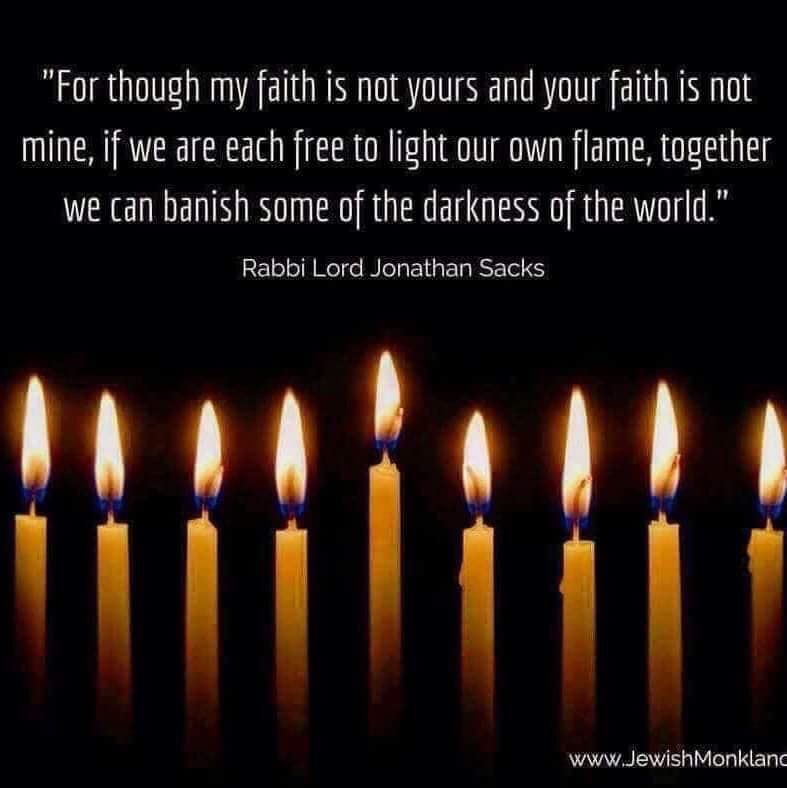
Hanukkah Begins 2022

בָּרוּךְ אַתָּה יְיָ אֱלֹהֵינוּ מֶלֶךְ הַעוֹלָם, שֶׁהֶחֱיָנוּ וְקִיְּמָנוּ וְהִגִּיעָנוּ לַזְּמַן הַזֶּה׃

בָּרוּךְ אַתָּה ה', אֱ-לֹהֵינוּ מֶלֶךְ הָעוֹלָם, אֲשֶׁר קִדְּשָׁנוּ בְּמִצְוֹתָיו, וְצִוָּנוּ לְהַדְלִיק נֵר שֶׁל חֲנֻכָּה.

בָּרוּךְ אַתָּה ה' אֱ-לֹהֵינוּ מֶלֶךְ הָעוֹלָם, שֶׁעָשָׂה נִסִּים לַאֲבוֹתֵֽינוּ בַּיָּמִים הָהֵם בַּזְּמַן הַזֶּה.


Blessed are You, Adonai our God, Sovereign of all, who has kept us alive, sustained us, and brought us to this season.

Blessed are You, Adonai our God, Sovereign of all, who hallows us with mitzvoth, commanding us to kindle the Hanukkah lights.

Blessed are You, Adonai our God, Sovereign of all, who performed wondrous deeds for our ancestors in days of old at this season.


Last night was the first night of Hanukkah, today marking the first full day.  The first candle has been lit, the three blessings above are offered.  The celebration will last for eight days and nights, from the evening of December 18 through the evening of December 26.

It is, ultimately, a time of remembrance, a celebration of God's provision.  In a time when there was no judge, no prophet, no word from God, He was still at work.  He was still performing miracles, protecting His people.  To make a single day's supply of oil last for eight days.  

It's a reminder that God is always at work.  Even when He is silent, even when He seems far away, God is still working.  God still cares for His people.  2022 may feel like that kind of year again, but rest assured, God is still at work.

To my Jewish friends and all who are celebrating, Happy Hanukkah!  May it be a blessed time for you and yours.


צ'ג אורים סמח


For those who would like a bit more background information, I've included the passages on Hanukkah from the books of the Maccabees and the Megillat Antiochus. The first passage relates to a reflection on Nehemiah's rededication of the temple and its own miracle. The second passage, on Judah Maccabee's rededication of the temple and the dedication of the festival. The final passage contains the story of the oil.


"Since on the twenty-fifth day of Chislev we shall celebrate the purification of the temple, we thought it necessary to notify you, in order that you also may celebrate the festival of booths and the festival of the fire given when Nehemiah, who built the temple and the altar, offered sacrifices.

For when our ancestors were being led captive to Persia, the pious priests of that time took some of the fire of the altar and secretly hid it in the hollow of a dry cistern, where they took such precautions that the place was unknown to anyone. But after many years had passed, when it pleased God, Nehemiah, having been commissioned by the king of Persia, sent the descendants of the priests who had hidden the fire to get it. And when they reported to us that they had not found fire but only a thick liquid, he ordered them to dip it out and bring it. When the materials for the sacrifices were presented, Nehemiah ordered the priests to sprinkle the liquid on the wood and on the things laid upon it. When this had been done and some time had passed, and when the sun, which had been clouded over, shone out, a great fire blazed up, so that all marveled. And while the sacrifice was being consumed, the priests offered prayer—the priests and everyone. Jonathan led, and the rest responded, as did Nehemiah. The prayer was to this effect:

'O Lord, Lord God, Creator of all things, you are awe-inspiring and strong and just and merciful, you alone are king and are kind, you alone are bountiful, you alone are just and almighty and eternal. You rescue Israel from every evil; you chose the ancestors and consecrated them. Accept this sacrifice on behalf of all your people Israel and preserve your portion and make it holy. Gather together our scattered people, set free those who are slaves among the Gentiles, look on those who are rejected and despised, and let the Gentiles know that you are our God. Punish those who oppress and are insolent with pride. Plant your people in your holy place, as Moses promised.'

Then the priests sang the hymns. After the materials of the sacrifice had been consumed, Nehemiah ordered that the liquid that was left should be poured on large stones. When this was done, a flame blazed up; but when the light from the altar shone back, it went out. When this matter became known, and it was reported to the king of the Persians that, in the place where the exiled priests had hidden the fire, the liquid had appeared with which Nehemiah and his associates had burned the materials of the sacrifice, the king investigated the matter, and enclosed the place and made it sacred. And with those persons whom the king favored he exchanged many excellent gifts. Nehemiah and his associates called this 'nephthar,' which means purification, but by most people it is called naphtha.
"

2 Maccabees 1:18-36

"Early in the morning on the twenty-fifth day of the ninth month, which is the month of Chislev, in the one hundred forty-eighth year, they rose and offered sacrifice, as the law directs, on the new altar of burnt offering that they had built.  At the very season and on the very day that the Gentiles had profaned it, it was dedicated with songs and harps and lutes and cymbals.  All the people fell on their faces and worshiped and blessed Heaven, who had prospered them.  So they celebrated the dedication of the altar for eight days, and joyfully offered burnt offerings; they offered a sacrifice of well-being and a thanksgiving offering.  They decorated the front of the temple with golden crowns and small shields; they restored the gates and the chambers for the priests, and fitted them with doors.  There was very great joy among the people, and the disgrace brought by the Gentiles was removed.

Then Judas and his brothers and all the assembly of Israel determined that every year at that season the days of dedication of the altar should be observed with joy and gladness for eight days, beginning with the twenty-fifth day of the month of Chislev.
"

1 Maccabees 4:52-59


"...After this, the sons of Israel went up to the Temple and rebuilt its gates and purified the Temple from the dead bodies and from the defilement. And they sought after pure olive oil to light the lamps therewith, but could not find any, except one bowl that was sealed with the signet ring of the High Priest from the days of Samuel the prophet and they knew that it was pure. There was in it [enough oil] to light [the lamps therewith] for one day, but the God of heaven whose name dwells there put therein his blessing and they were able to light from it eight days. Therefore, the sons of Ḥashmonai made this covenant and took upon themselves a solemn vow, they and the sons of Israel, all of them, to publish amongst the sons of Israel, [to the end] that they might observe these eight days of joy and honour, as the days of the feasts written in [the book of] the Law; [even] to light in them so as to make known to those who come after them that their God wrought for them salvation from heaven. In them, it is not permitted to mourn, neither to decree a fast [on those days], and anyone who has a vow to perform, let him perform it."

Megillat Antiochus

Sunday, December 18, 2022

Fourth Sunday of Advent 2022 - Break Forth, O Beauteous Heavenly Light

On the fourth and final Sunday of Advent, we celebrate the love of God.  The greatest gift ever given! That an omnipotent, omnipresent God would step into time and space, into a moment, to live among His creation and to sacrifice Himself to provide a pathway for its restoration.

"For God so loved the world that he gave his one and only Son, that whoever believes in him shall not perish but have eternal life. For God did not send his Son into the world to condemn the world, but to save the world through him. Whoever believes in him is not condemned, but whoever does not believe stands condemned already because they have not believed in the name of God's one and only Son. This is the verdict: Light has come into the world, but people loved darkness instead of light because their deeds were evil."

John 3:16-19


"The Word became flesh and made his dwelling among us. We have seen his glory, the glory of the one and only Son, who came from the Father, full of grace and truth."

John 1:14


"And there were shepherds living out in the fields nearby, keeping watch over their flocks at night. An angel of the Lord appeared to them, and the glory of the Lord shone around them, and they were terrified. But the angel said to them, “Do not be afraid. I bring you good news that will cause great joy for all the people. Today in the town of David a Savior has been born to you; he is the Messiah, the Lord. This will be a sign to you: You will find a baby wrapped in cloths and lying in a manger.”
Suddenly a great company of the heavenly host appeared with the angel, praising God and saying,

“Glory to God in the highest heaven,
    and on earth peace to those on whom his favor rests.”

When the angels had left them and gone into heaven, the shepherds said to one another, “Let’s go to Bethlehem and see this thing that has happened, which the Lord has told us about.”

So they hurried off and found Mary and Joseph, and the baby, who was lying in the manger. When they had seen him, they spread the word concerning what had been told them about this child, and all who heard it were amazed at what the shepherds said to them. But Mary treasured up all these things and pondered them in her heart. The shepherds returned, glorifying and praising God for all the things they had heard and seen, which were just as they had been told."

Luke 2:8-20

"This is love: not that we loved God, but that he loved us and sent his Son as an atoning sacrifice for our sins."
1 John 4:10

I pray you have a wonderful day in the Lord this Advent Sunday and are able to fully appreciate the love of God as it has been poured out to us.

The message remains the same.  Good news that will bring great joy to all.

And in so doing, let's go and tell.  It is good news after all.

Saturday, December 17, 2022

Yuletide - The Child - Joy of Man's Desiring

"Child in the manger,
Infant of Mary;
Outcast and stranger, 
Lord of all;
Child who inherits
All our transgressions,
All our demerits
On Him fall."


“But when the time had fully come, God sent his Son, born of a woman, born under law, to redeem those under law, that we might receive the full rights of sons.”

Galatians 4:4-5

There is a tendency in Christianity to downplay the humanity of Jesus.  We know and will say he was "fully human" and "fully God," but in our reading of scripture and description of the events of Jesus life, we'll often shift our focus bad to his divinity, because we know the whole story.  We know the ending, we know the full displays of his power, so it colors our view of his entire life.  

We downplay just how human he really was.

The Nativity story should put any such notion to rest.

If Jesus simply arrived on the scene as a fully grown adult and started his ministry, questions of his humanity would be justified.  Mythologies and other religions are rife with gods appearing to men.  In the scriptures themselves, we have heavenly beings appear to men.  Angels and messengers.  If Jesus appeared fully formed, it would be easy to believe he was just an angel or some other heavenly being.

This moves Jesus farther away from us.  As one who cannot relate, but instead as one who has simply come to instruct.  One whose suffering was somehow easier because of his divine ability to endure it.

But by appearing as a child, Jesus assures us of his humanity.

No matter how much we would like to portray his birth as a silent night, or that there was no crying that he made that night, I assure you, Jesus cried as a baby.  It would have been his only way to communicate with his parents.  

Yes, he cried, and perhaps hollered and screamed.  He wet himself.  He soiled himself.  He would have vomited.  Made messes.  Worried his human parents.  He got hungry.  Tired.  Frustrated.  Upset.

His life was messy.  Like ours.  

God Himself stepped down to earth, into a form totally dependent on human parents.  Needing their provision, their protection, their attention.  Unable to do even the simplest tasks for himself.

You can almost imagine the times he would be just like every other child.  And then, something would happen to remind Mary and Joseph of how truly special he was.

We can estimate that the rest of Jesus's childhood and young adulthood would have been similar.  We only have accounts of him as a very young child and then the account of him in the temple, around age twelve.  The rest of his formative years must have been largely uneventful, because when his ministry started, he had no notoriety.  The people who saw him grew up around them asked, "isn't that the carpenter's son?"  And his miracles that began with his ministry seemed surprising and drew attention.

Yes, the infant Jesus reminds us of how much he has in common with all of us.  How he truly can relate to us.  How he knows our struggle, and not just from an outside perspective.  He lived it.

And he lived it because of His compassion for us.  He sees our need and is moved to act.  "For God so loved..."

That's the good news that brings great joy.  That's what causes the angels to rejoice and calls for us to do the same.

Glory to God in the Highest
And on earth, peace

“For we do not have a high priest who is unable to sympathize with our weaknesses, but we have one who has been tempted in every way, just as we are—yet was without sin”

Hebrews 4:15

"Once the most holy
Child of salvation
Gently and lowly
Lived below;
Now as our glorious
Mighty Redeemer,
See Him victorious
O'er each foe."

Friday, December 16, 2022

Yuletide - Las Posadas 2022

¡Entren santos peregrinos!
¡Reciban éste rincón!
Que aunque es pobre la morada
¡Se las doy de corazón!
¡Cantemos con alegría!
¡Todos al considerar!
¡Que Jesús, José y María
nos vinieron hoy a honrar!


Come in holy pilgrims!
Receive this corner!
Because, even though the place is poor
I offer it to you from my heart!
Let's sing it with joy!
Everyone at the thought!
That Jesus, Joseph, and Mary
Came to honor us today!


In Latin American and Hispanic Christianity, today marks the beginning of Las Posadas, a novenario, or nine day period of prayer and procession, reflecting on the journey of Joseph and Mary through Bethlehem looking for shelter.  The nine day period leading up to Christmas Day is also meant to reflect on the nine months Mary carried the Messiah.  

Las Posadas derives from the Spanish word posada, meaning lodging or accommodation, here referring to the inn in the Nativity story.  Celebration of this 400 year tradition starts with two actors dressing as Mary and Joseph, leading a procession to certain houses designated as inns, usually those at the end of a street.  The procession is headed by a leader carrying a luminaria and can often contain other players of the Nativity story (angels, shepherds, etc.).  The procession makes its way from house to house, singing carols in hopes to have a place to stay.  They are initially met with "no posada," no room, until the end of the street.  There, the residents of the houses respond by singing a song, recognizing Mary and Joseph, and allowing the procession to enter.  The procession comes in and kneels to pray before a Nativity scene.  At the end of each night, carols are sung, children break open a star shaped piñata, and everyone sits for a feast.  This is repeated throughout the nine day period, with a new house each night accepting them in for the festivities.

My introduction to Las Posadas came through The Three Caballeros.  That film was part of Disney's Good Neighbor program, an extension of the United States' government's policy at the time, designed to highlight the relationship with South America.  As a result, The Three Caballeros and its sister production, Saludos Amigos, are both a mixture of travelogue, history lesson, art appreciation, and animation.  In The Three Caballeros, both Jose Carioca and Panchito Pistoles, reveal the best aspects of their countries, Brazil and Mexico, respectively.  Panchito includes a description of Las Posadas, complete with beautiful Mary Blair, small world-esque paintings to accompany the story.  The image above includes examples of this art.

That film introduced me to the beauty of this celebration.  A real visual and tactile experience of what Mary and Joseph would have experienced that cold night.  Traveling from inn to inn looking for someplace for shelter, some place for refuge.  Repeatedly encountering doors slammed in their face.  "No room."  "No posada."

Another reminder that our sanitized version of the Christmas story leaves much to be desired.  We revere that night so much (and rightly so), that we forget it was not the safe, pleasant pageant we've made it.  It wasn't a silent night.  It wasn't likely a midnight clear.  It was cold, it was noisy, it was smelly, it was dark.  For Mary and Joseph that night held fear and trepidation.  Would they find shelter?  Would there be a safe place for Mary to bear this child?  When the only place they were offered was a stable, would it be warm enough?  Would it be enough?

It also reminds us of what our response is to be.  We are to make room for the Savior.  In doing so, we are to make room for his people.  Making room for the Savior on that first Christmas night meant providing shelter for his mom and dad.  Meeting this family in need of refuge and allowing them in.  Allowing dirty shepherds into the space to come and see him.  

It means caring for the stranger.

It means caring for the refugee.

It means treating each person with the kindness we would afford him, because they are made in his image.

It means making room.

I pray this Christmas season you make room for those in need around you.  There is a lot of need this year.  From those families still separated at the border, to those suffering from compounded depression, to those wondering where there next paycheck will come from in this uncertain year, and to those grieving loss from this pandemic.  The Christmas story is messy in order to remind us that regardless of the humble circumstances, even though our place is poor, God still stepped down into it.  And we are to do the same.

¡Entren santos peregrinos!

Thursday, December 15, 2022

Yuletide - Done in Your Name

"But soon the steeples called good people all, to church and chapel, and away they came, flocking through the streets in their best clothes, and with their gayest faces. And at the same time there emerged from scores of bye-streets, lanes, and nameless turnings, innumerable people, carrying their dinners to the bakers’ shops. The sight of these poor revellers appeared to interest the Spirit very much, for he stood with Scrooge beside him in a baker’s doorway, and taking off the covers as their bearers passed, sprinkled incense on their dinners from his torch. And it was a very uncommon kind of torch, for once or twice when there were angry words between some dinner-carriers who had jostled each other, he shed a few drops of water on them from it, and their good humour was restored directly. For they said, it was a shame to quarrel upon Christmas Day. And so it was! God love it, so it was!

In time the bells ceased, and the bakers were shut up; and yet there was a genial shadowing forth of all these dinners and the progress of their cooking, in the thawed blotch of wet above each baker’s oven; where the pavement smoked as if its stones were cooking too.

“Is there a peculiar flavour in what you sprinkle from your torch?” asked Scrooge.

“There is. My own.”

“Would it apply to any kind of dinner on this day?” asked Scrooge.

“To any kindly given. To a poor one most.”

“Why to a poor one most?” asked Scrooge.

“Because it needs it most.”

“Spirit,” said Scrooge, after a moment’s thought, “I wonder you, of all the beings in the many worlds about us, should desire to cramp these people’s opportunities of innocent enjoyment.”

“I!” cried the Spirit.

“You would deprive them of their means of dining every seventh day, often the only day on which they can be said to dine at all,” said Scrooge. “Wouldn’t you?”

“I!” cried the Spirit.

“You seek to close these places on the Seventh Day?” said Scrooge. “And it comes to the same thing.”

“I seek!” exclaimed the Spirit.

“Forgive me if I am wrong. It has been done in your name, or at least in that of your family,” said Scrooge.

“There are some upon this earth of yours,” returned the Spirit, “who lay claim to know us, and who do their deeds of passion, pride, ill-will, hatred, envy, bigotry, and selfishness in our name, who are as strange to us and all our kith and kin, as if they had never lived. Remember that, and charge their doings on themselves, not us.”"

A Christmas Carol, Charles Dickens


This passage of A Christmas Carol has become a repeated meditation in the holiday season.  A brief interlude where Scrooge seems to be thawing because of the Ghost of Christmas Present's presence, but still gets in to a lively debate regarding work, pleasure, and the efforts of the moral majority, of "good Christians" at the time.  

Scrooge recognizes that for the poor, often Sunday is their only source of enjoyment.  Their only good meal.  The strive of all their labors.  What makes it bearable, sustainable.  

Scrooge also knows that there are “blue law” efforts in his society to, under the guise of being a good “Christian” society, close all commercial shops—including bakeries—on Sundays. Accordingly, Scrooge accuses the Ghost of hypocrisy.

The Ghost of Christmas Present naturally takes offense, saying it is not he that seeks to deprive them of their means.  And Scrooge then utters the words that I want to focus on.  "It has been done in your name."

How much ill do we do in the name of Christmas?

The commercialism.  The comparison.  The holiday blues, the holiday rage.

Kris Kringle: Imagine...making a child take something it doesn’t want…just because he bought too many of the wrong toys. That’s what I’ve been fighting against for years…the way they commercialize Christmas.

Alfred: A lot of bad ‘isms’ floating around in this world…but one of the worst is commercialism. Make a buck. Make a buck. Even in Brooklyn, it’s the same. Don’t care what Christmas stands for. Just make a buck.

Alfred:  A lot of bad ‘isms’ floating around in this world…but one of the worst is commercialism.  Make a buck.  Make a buck.  Even in Brooklyn, it’s the same.  Don’t care what Christmas stands for.  Just make a buck.it doesn't want...
just because he bought
too many of the wrong toys.
That's what I've been
fighting against for years...
the way they
commercialize Christmas.
A lot of bad "isms"
floating around this world...
but one of the worst
is commercialism.
Make a buck. Make a buck.
Even in Brooklyn,
it's the same.
Don't care what Christmas
stands for.
Just make a buck.

Read more: https://www.springfieldspringfield.co.uk/movie_script.php?movie=miracle-on-34th-street

making a child take something
it doesn't want...
just because he bought
too many of the wrong toys.
That's what I've been
fighting against for years...
the way they
commercialize Christmas.
A lot of bad "isms"
floating around this world...
but one of the worst
is commercialism.
Make a buck. Make a buck.
Even in Brooklyn,
it's the same.
Don't care what Christmas
stands for.
Just make a buck.

Read more: https://www.springfieldspringfield.co.uk/movie_script.php?movie=miracle-on-34th-street
Even worse, how much ill do we do in the name of Christ?  How much ill do we do with good intentions but with horrible, inevitable effects?

How much do we associate the name of Christ with hate, with malice, with greed, with strife?

How much evil are we doing in the name of Christ by associating him with a singular political party?

Marilynne Robinson’s wrote in her novel Gilead: “We human beings do real harm. History could make a stone weep.”

The past is littered with historical evils that have been done in the name of Christ.  The Crusades, the Spanish Inquisition, forced conversions of aboriginal peoples.  Blood libel.  Slavery.

What are we doing today, what are we allowing today that is the same?  

Forced separation of migrant families seeking asylum.  

White nationalism that proclaims that God appointed a superior race.

Support for horribly damaging conversion camps because we are too afraid to have real open conversations about religion and sex, especially at younger ages when it would be most beneficial.

Division and hatred directed at half the country because fear is a great political tool.

When will we engage in the Biblical practice of lament?

More than any other, Christmas should be a time to force us to cut through all the division, all the rancor, all the strife.  To really look at what we claim in the name of the child.  What we claim in the name of the God who became man to save all.  To redeem all, to restore all.

Who appeared to the lowliest of us all, to shame the high and mighty.  Who appeared to outsiders, to the scandalous, to the wretched, to shame the pious.

“There are some upon this earth of yours,” returned the Spirit, “who lay claim to know us, and who do their deeds of passion, pride, ill-will, hatred, envy, bigotry, and selfishness in our name, who are as strange to us and all our kith and kin, as if they had never lived. Remember that, and charge their doings on themselves, not us.”

"The Advent and Christmas seasons provide those of us who claim the Christian faith with the opportunity to consider the various ways in which we—all of us, regardless of political persuasion or version of Christianity—regularly distort, twist, and often besmirch the name of the very faith we claim in ways that have nothing to do with the good news of the gospel. We all, either actively or through neglect and passivity, have been party to allowing, in the Ghost of Christmas Present’s words, “deeds of passion, pride, ill will, hatred, envy, bigotry, and selfishness [to be done] in our name.” Ebenezer Scrooge learned many things from the ghosts who visited him, but none more important than this: it is possible both to become aware of things one has been blind to and to change. May we all go and do likewise."  Vance Morgan, "It Has Been Done In Your Name: A Dickensian Tale of "Good Christians" Doing Harm


As we come forth and know Him better, may we also go and do likewise, indeed.  

And then, and only then, will God bless us, one and all.

Wednesday, December 14, 2022

Yuletide - The Ghost of Christmas Present

"Come in and know me better, man"

A Christmas Carol is a story that gets a lot of play in our house during this time of year.  We have the recent Jim Carrey motion capture version that Jamie used in class, as it is one of the most faithful adaptations.  We watch Mickey's Christmas Carol for Scrooge McDuck (lovingly homaged in last year's Ducktales Christmas episode).  We watch the derivations of the story, like Rod Serling's haunting Carol for Another Christmas or the noir Cash on Demand.  And of course, we watch the best adaptation of them all - Muppet Christmas Carol.  I'm not joking on that last part.  Michael Caine has to be one of the best Ebeneezer Scrooge's ever because he plays the role with such sincerity.  The perfect straight-man while surrounded by Muppets.  Someday soon, we'll have to catch the Indiana Repertory Theater's annual version. (Jamie was this close this year to going with a class).

Over the last several years, the Ghost of Christmas Present has become a fascinating figure to me.  A Father Christmas like figure.  A giant of a man - a symbol of plenty.  A cornucopia for a torch and a bountiful feast before him.  And through his journey he shows Scrooge the abundance of the celebration, even for those of meager means.

I also love the detail of him carrying an empty scabbard.  A symbol of the message the angels brought for this time of year, "on Earth peace, goodwill toward men."  The sword is not needed, the Savior is here.

The spirit also serves as a reminder to us of the fleeting nature of the present.  He exists only for the season and each year, a new brother is born.  In Dickens' text, it seems he lives for the Twelve Days of Christmas, as he disappears on the stroke of midnight on Twelfth Night, the eve of Epiphany or Three Kings' Day.  He is a reminder for us to "be present."  The spirit is merry because of his focus on the celebration of the night.  Unburdened by the mistakes of the past or the worries of the future, the Ghost of Christmas Present can enjoy the merriment of the season.  He can spread his light and warmth from his torch as he travels.

That is not to say that this spirit ignores the realities that many face over the holidays.  He shows Scrooge scenes of deprivation as well as plenty. And it is this spirit that gives Scrooge perhaps the most pressing warnings.  Warnings that all would do well to heed.

Toward the end of his visit, the spirit reveals to Scrooge two emaciated children, a boy and a girl, clinging to his robes. Ignorance and Want.  The boy is Ignorance and the girl is Want.  They are man's children.  "Beware them both, and all of their degree, but most of all beware this boy, for on his brow I see that written which is Doom unless the writing be erased."

The ills of Want are quite apparent.  Want represents the need we see all around us.  Homelessness, hunger, poverty, and neglect.  All social ills that we recognize and prioritize trying to address.  "Our people must learn to devote themselves to doing what is good, in order to provide for urgent needs and not live unproductive lives."  Titus 3:14  We do so, because we recognize the dark ends that Want leads to:  disease, abuse, suffering, desperation, and death.  All ends we would seek to avoid.

The ills of Ignorance are less obvious, but far more dangerous.  Ignorance prolongs and worsens Want.  For Ignorance keeps us in fear: we fear what we do not know and understand.  It is ignorance that prolongs racism, sexism, homophobia, xenophobia, religious intolerance, and hate.  For it is much easier to hate that which you do not know or understand.   It is Ignorance that looks at someone who is begging and assumes that they have not even tried to look for a job.  It is Ignorance that assumes that same person would just spend any money on alcohol or drugs.

And it is Ignorance that we first must tackle so that we can address Want.   "Desire without knowledge is not good, and whoever makes haste with his feet misses his way."  Proverbs 19:2  That is the warning of the Ghost of Christmas Present.  Why Ignorance is to be feared more.  For it is Ignorance that will bring our doom, unless it is changed.

We see this through the character of Scrooge himself.  The first thing that is changed through his travels with the spirits is his ignorance to the world around him.  Through his travels, he becomes aware of the joys and the sorrows that surround him, breaking through his narcissism and myopic greed.  Through the removal of his ignorance, his heart can be changed.  And from that, he can be moved to address the wants that are all around him.  The want of the Cratchit family for basic provisions.  Tiny Tim's want for nourishment to help heal him.  Fred's want for family connection.

May we all be present this Christmas season.  Aware of those around us and open to their needs.  May we not let ignorance lead us, but may we seek to address want where it is found and meet it. May we share our abundance and bounty with those around us.  May we embody the peace of the season and may we rejoice in it.  And may we never forget the reason for Christmas past, present, and future.

Come, let's know Him better.

Tuesday, December 13, 2022

Yuletide - King Herod and His Advisors - An Adventure in Missing the Point


"In the time of King Herod, after Jesus was born in Bethlehem of Judea, wise men from the East came to Jerusalem, asking, "Where is the child who has been born king of the Jews? For we observed his star at its rising, and have come to pay him homage." 

When King Herod heard this, he was frightened and all Jerusalem with him; and calling together all the chief priests and scribes of the people, he inquired of them where the Messiah was to be born. They told him, "In Bethlehem of Judea; for so it has been written by the prophet: 

'And you, Bethlehem, in the land of Judah, are by no means least among the rulers of Judah; for from you shall come a ruler who is to shepherd my people Israel.'" 

Then Herod secretly called for the wise men and learned from them the exact time when the star had appeared. Then he sent them to Bethlehem, saying, "Go and search diligently for the child; and when you have found him, bring me word so that I may also go and pay him homage." 

When they had heard the king, they set out; and there, ahead of them, went the star that they had seen at its rising, until it stopped over the place where the child was. When they saw that the star had stopped, they were overwhelmed with joy. On entering the house, they saw the child with Mary his mother; and they knelt down and paid him homage. Then, opening their treasure chests, they offered him gifts of gold, frankincense, and myrrh. And having been warned in a dream not to return to Herod, they left for their own country by another path."
Matthew 2:1-12

It's important to counter the Magi's presence in the story with the people that they questioned first - King Herod and his advisors.  Their reaction is so completely opposite to that of these wise men, that they cannot be ignored.

Primarily, Herod serves an important function in the story because it grounds the Nativity in history.  Like most of Luke's writings, it provides a verifiable historical context to the Gospel account and allows us to compare and prove Jesus's place in history.  Historians agree that Herod in many respects had a very successful reign.  Ethnically Idumaean, or Edomite, but at least nominally of Jewish practice, he increased the land he governed from Palestine to parts of modern Jordan, Lebanon and Syria, constructing fortresses, aqueducts and amphitheaters.  

His connections to Julius Caesar and Caesar Augustus would provide  both comfort and strife.  He was given the title “King of the Jews” by Caesar because of the Jewish population he ruled, to their consternation.  Like most kings, he wanted more and more power.  This pushed him to rule with an iron fist and led to increasing levels of paranoia.  He executed many of his own family to stave off what he saw as threats to his rule.

He has been described as "perhaps the only figure in ancient Jewish history who has been loathed equally by Jewish and Christian posterity," "the evil genius of the Judean nation," and as one who would be "prepared to commit any crime in order to gratify his unbounded ambition."

Perhaps now we can understand better why news of a new Jewish king being born would be so troubling to him.  Jesus represented the one thing he feared the most in the world: losing his position of power and authority.

If Herod's response to this baby king is one of fear and anger, his advisors response seems to be one of apathy.

When the wise men ask Herod where the child was prophesied to be born, he then turns to the chief priests and scribes.  Their response, or lack thereof, is the most interesting part of this account.  Of course they of all people would know the scriptures, and would know the prophecies.  They knew everything about the coming Messiah.  They could have answered any question about the Messiah that had been posed to them.

They simply had no desire to seek him out.

Think about it.  They saw the same star in the heavens as the wise men.  They saw it centered over Bethlehem.  They had to know something significant was occurring in the stars.  The Magi's story would have filled in important pieces of their own observations.  

But for whatever reason, they didn't care enough to find out exactly what was happening.

We don't know if it was fear of Herod that kept them from acting.  That would have been a perfectly rational response.  They knew everything Herod did to keep power, and would have been rightly afraid of his reaction.

Perhaps they were so wrapped up in their own power and position that they never even paid attention to the star.  Perhaps even after hearing the story of the Magi, they no longer had any inclination to seek the Messiah.  After all, God had been silent for 400 years, why would he show up to outsiders and not them?

For whatever reason, their response to the Magi's tale was silence and inaction.  They did nothing.  They heard of the possibility of the arrival of the Messiah and they flat out ignored it.

It's a stark reminder for us to not ignore the signs around us.  To not ignore where the Lord is working around us.  

To expect Him.  And to seek Him out.

As wise men still do.

Monday, December 12, 2022

Yuletide - The Magi - From Reason to Faith

"Bringing our gifts for the newborn Savior 
All that we have, whether costly or meek 
Because we believe 
Gold for his honor, and frankincense for his pleasure 
And myrrh for the cross he will suffer 
Do you believe? 
Is this who we've waited for?"


"In the time of King Herod, after Jesus was born in Bethlehem of Judea, wise men from the East came to Jerusalem, asking, "Where is the child who has been born king of the Jews? For we observed his star at its rising, and have come to pay him homage." 


When King Herod heard this, he was frightened and all Jerusalem with him; and calling together all the chief priests and scribes of the people, he inquired of them where the Messiah was to be born. They told him, "In Bethlehem of Judea; for so it has been written by the prophet: 

'And you, Bethlehem, in the land of Judah, are by no means least among the rulers of Judah; for from you shall come a ruler who is to shepherd my people Israel.'" 

Then Herod secretly called for the wise men and learned from them the exact time when the star had appeared. Then he sent them to Bethlehem, saying, "Go and search diligently for the child; and when you have found him, bring me word so that I may also go and pay him homage." 

When they had heard the king, they set out; and there, ahead of them, went the star that they had seen at its rising, until it stopped over the place where the child was. When they saw that the star had stopped, they were overwhelmed with joy. On entering the house, they saw the child with Mary his mother; and they knelt down and paid him homage. Then, opening their treasure chests, they offered him gifts of gold, frankincense, and myrrh. And having been warned in a dream not to return to Herod, they left for their own country by another path."
Matthew 2:1-12

Continuing in the biblical story of Jesus's birth, we have to jump for the account of the visit of the Magi.  

There are many facts about this encounter that are left unexplained.  First, we don't know exactly when they arrived.  They likely arrived several months after the birth of Jesus.  We don't know exactly how many, but it could be as much as twenty-four months or two years.   So, despite what your nativity scene may show, the Magi were not present at the stable.  

Further, we don't know exactly how many Magi traveled to meet the child.  Our songs and some traditions assume three because of the three gifts that they brought.  Other traditions include as many as twelve.  

We don't know exactly where they came from.  It is indicated that they came from the East, but there is no further indication of the region.  Many believe they could come from the areas of Persia or even India.

We don't know what they rode. whether camels or donkeys.  We don't know their names, though some are ascribed to them.  We don't know their fates.  We just see their importance in the birth story.

For the Magi represent a common thread in scriptures: the idea of the righteous outsider.  

The idea of someone outside the faith, outside the Israelite nation, who saw the power of Almighty God and believed.  Often, especially when the Israelites, the chosen themselves did not see it or believe.

Though the Magi came from another faith, likely Zoroastrianism, they recognized the importance of the signs in the heavens that they witnessed.  They recognized the majesty and wonder of the star and came asking "Where is the child?  Where is the one born King of the Jews?"  The priests, the Levites, the Jewish rulers of the day undoubtedly had see the same star, had seen the same signs in the heavens.  But only the Magi recognized their importance and felt compelled to do something about it.

The Magi, to me, also represent the idea of how wisdom and reason can lead to faith.  Despite the often insistence of Conservative Christianity that science and faith are diametrically opposed, the pursuit of knowledge has been one of the many paths that has led several of our important theological figures to belief.  C.S. Lewis famously turned from atheism to faith through reason.  Several current writers have made their notoriety in making A Case for Christ or stating that they Don't Have Enough Faith to be an Atheist.  People whose pursuit of knowledge, pursuit of wisdom, and intellectual curiosity lead them to Christ.

It's as if in many churches we forget there are Intuitive and Feeling personality types.  We get those who come to Christ through an emotional appeal. Who hear that great conversion story and are moved by it.

We're not sure what to do with those who respond more to facts than to emotions.  Who won't accept easy answers.  Who will question and will push and dig further and further into the historicity of scripture, the battles in church history, canonicity, and translation, and tradition.  Who will challenge the system.

We have to be better equipped to answer both.

The Magi remind us why.  The Magi's knowledge of astronomy and astrology led them to understand the significance of what they saw in the stars.  Their knowledge of other religions led them to understand the importance that this sign meant to the Jewish people.  Their intellectual curiosity spurred them out of their laboratories and studies and into the West to see what would warrant such a display.

In their intelligence, they brought gifts perfectly suited for the new Messiah.  Gold, a gift for a king, for royalty.  Frankincense, a gift for a god, for divinity.  Myrrh,  a gift for the dead, for a sacrifice.  All costly, and all significant.

Oh that we could share in that same wisdom.  In that same curiosity, which pushes us to pursue the Christ child further and further.

And which leads us to share in that exceeding great joy of discovery.